From Disgust to Humanity by Nussbaum Martha C
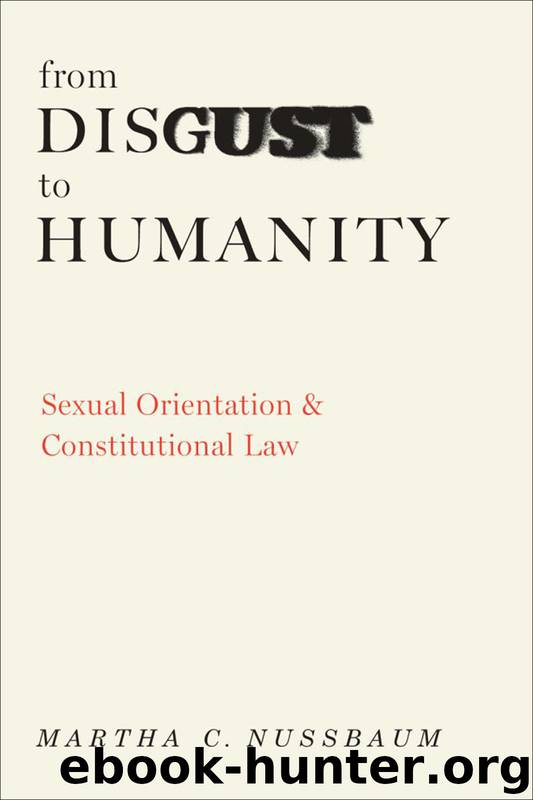
Author:Nussbaum, Martha C.
Language: eng
Format: epub
Publisher: Oxford University Press, USA
Published: 2010-07-27T16:00:00+00:00
2. ACT 1: COLORADO—FUNDAMENTAL RIGHTS AND THE POLITICAL PROCESS
The litigation surrounding Amendment 2 was complicated, involving three distinct legal theories. Following these will give us further insight into what support for the amendment was really about and why its rejection by the Supreme Court was right.
Act 1 of the drama was the plaintiffs’ motion, before District Court Judge H. Jeffrey Bayless, for a preliminary injunction against the implementation of the law. Throughout the initial phases, the plaintiffs were trying to find a way of ensuring that the state would have to show not simply a rational basis for the law, but a compelling state interest. Most laws are upheld on rational basis review, so, despite the fact that the plaintiffs consistently argued that the law lacked even a rational basis, a key part of their strategy was to devise some theory that would move Amendment 2 into the category of laws for which heightened scrutiny was required.
There are two ways in which such an argument may be made under the Equal Protection Clause of the Fourteenth Amendment. First, one can argue that classification of people on the basis of their sexual orientation is a suspect classification, an idea explored in chapter 2. That strategy seemed unlikely to succeed, because it had not succeeded in other cases. Second, one can argue, as we saw in chapter 3, that the challenged law infringes one of the unenumer-ated “fundamental rights” that have been recognized as inherent in the Equal Protection Clause, such as the right to vote and the right to travel.
During act 1, the plaintiffs elaborated a clever version of the latter strategy, which was endorsed by the Colorado Supreme Court.9 They argued that Amendment 2 deprives gays and lesbians of the right to “participate equally in the political process,” by “fencing” them “out” from the opportunity, which all other citizens enjoy, to pass local and state laws protecting their interests. They rested this argument on a group of cases involving reapportionment, minority party rights, and various other attempts to “limit the ability of certain groups to have desired legislation implemented through the normal political processes.” The Colorado Supreme Court argued that, although the precedents all involved race, the core of the argument did not rest on the notion of racially suspect classification, but rather, on the principle that the Equal Protection Clause “guarantees the fundamental right to participate equally in the political process and that any attempt to infringe on an independently identifiable group’s ability to exercise that right is subject to strict judicial scrutiny.”
This was an interesting legal theory, but it had its problems. First of all, the ballot-access and right to vote cases were being stretched, in order to find a general right to participate as equals in the political process.10 More puzzling was the theory’s use of the notion of “an independently identifiable group.” Obviously this could not mean only those groups who already enjoyed suspect classification status, or gays and lesbians would be excluded. On the other
Download
This site does not store any files on its server. We only index and link to content provided by other sites. Please contact the content providers to delete copyright contents if any and email us, we'll remove relevant links or contents immediately.
Day by Elie Wiesel(2786)
The Age of Genius by A. C. Grayling(2592)
Gideon's Spies: The Secret History of the Mossad by Gordon Thomas(2356)
The Gulag Archipelago (Vintage Classics) by Aleksandr Solzhenitsyn(2106)
FATWA: Hunted in America by Pamela Geller(2013)
Columbine by Dave Cullen(1870)
Men Explain Things to Me by Rebecca Solnit(1729)
The Rule of Law by Bingham Tom(1702)
Anatomy of Injustice by Raymond Bonner(1671)
Examples & Explanations: Administrative Law by William F. Funk & Richard H. Seamon(1649)
Three Cups of Tea by Greg Mortenson(1621)
The Source by James A. Michener(1619)
That Every Man Be Armed by Stephen P. Halbrook(1584)
ADHD on Trial by Michael Gordon(1581)
Future Design by Unknown(1580)
Gideon's Spies by Gordon Thomas(1512)
Palestinian Walks by Raja Shehadeh(1499)
Constitutional Theory by Carl Schmitt(1458)
Nothing to Envy by Barbara Demick(1451)
